

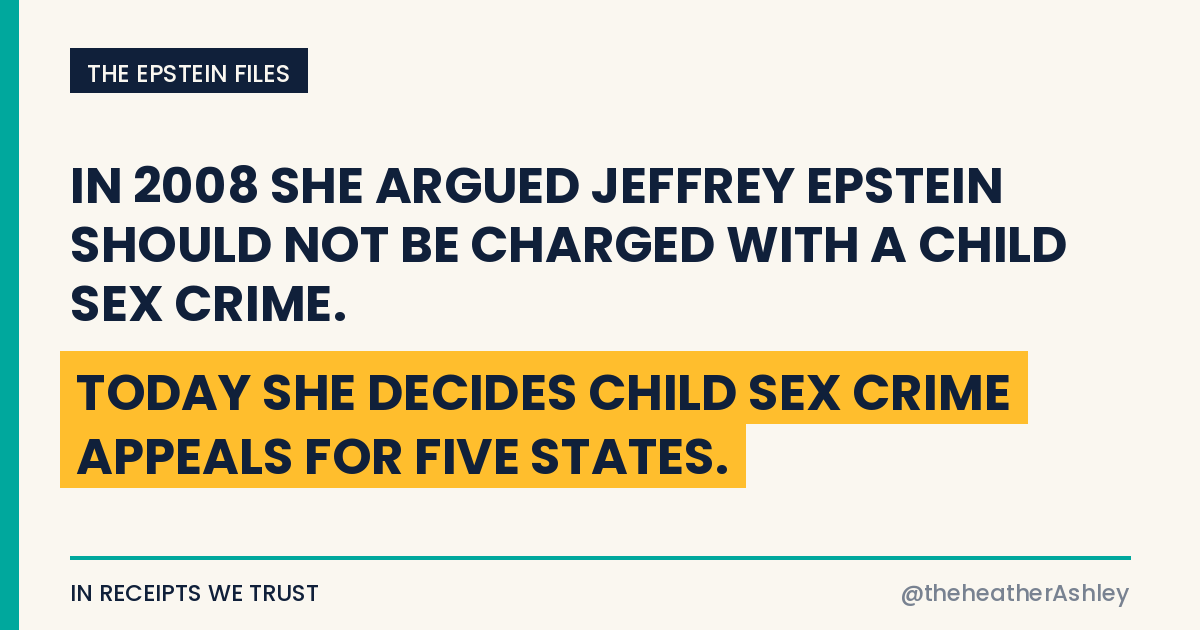
In May 2008, the chief of the Justice Department unit that prosecutes those who sexually exploit children sat down to write a letter to Jeffrey Epstein’s lawyer. In the middle of it, he pointed out something pretty alarming.

“Particularly in cases involving exploited children, as one member of your defense team, Ms. Thacker, surely knows from her work at CEOS, it is not uncommon for victim-witnesses to give conflicting statements.” (EFTA00235633 Page 308)
CEOS is the Child Exploitation and Obscenity Section, the Main Justice unit that handles federal child sex crimes.
Ms. Thacker is Stephanie Thacker. Two years earlier she had been its Principal Deputy Chief, the number two job in the section. Now she was working for Epstein, and her old colleagues were calling her out.
Less than four years later, the Senate confirmed her to a federal appeals court, 91 to 3. She is still on that bench today.
Who she was
Thacker joined CEOS in 1999 and left in 2006. Her own account of what she did there is sitting in the letter she wrote for Epstein.
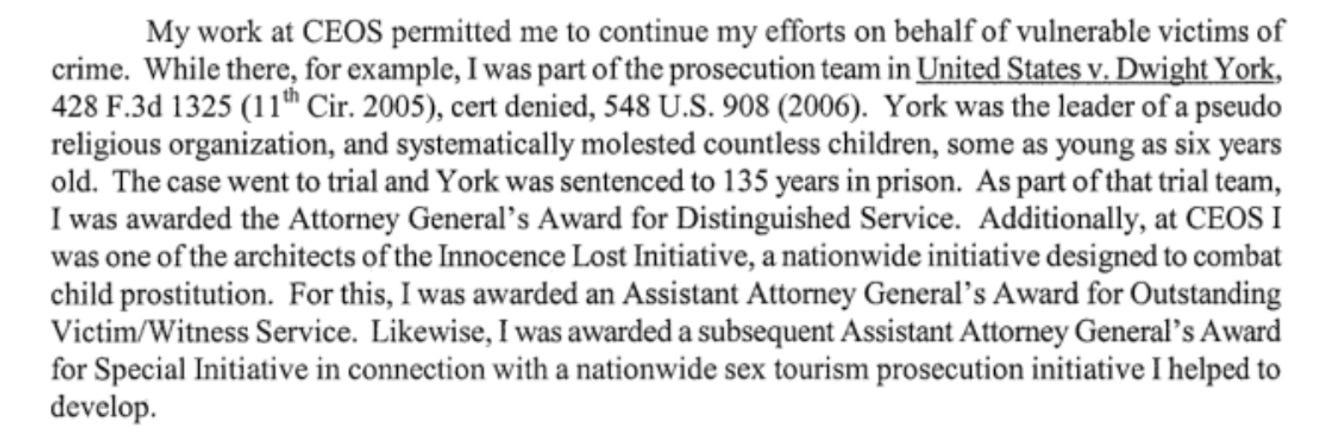
She was on the team that brought the first prosecution in the country under the Violence Against Women Act. She was on the team that convicted Dwight York, a cult leader who, in her words, “systematically molested countless children, some as young as six years old.” York was sentenced to 135 years. Thacker received the Attorney General's Award for Distinguished Service as part of that trial team.
Thacker wrote that at CEOS she was “one of the architects of the Innocence Lost Initiative, a nationwide initiative designed to combat child prostitution.” She helped build the federal program for going after those who exchange money to sexually exploit minors.
She spent two pages of the letter on all of that, and then explained why…

She’s using her resume as an argument - telling the Justice Department that she of all people would know a child exploitation case when she saw one, and this isn’t one of them.
What the government already said
The CEOS letter went out May 15, 2008. It runs 6 pages long and was signed by section chief Andrew Oosterbaan (EFTA00235631 Page 306). It concluded that U.S. Attorney Alex Acosta “could properly use his discretion to authorize prosecution in this case.” Basically just reaffirming that charging Epstein would be a legitimate call. Duh.
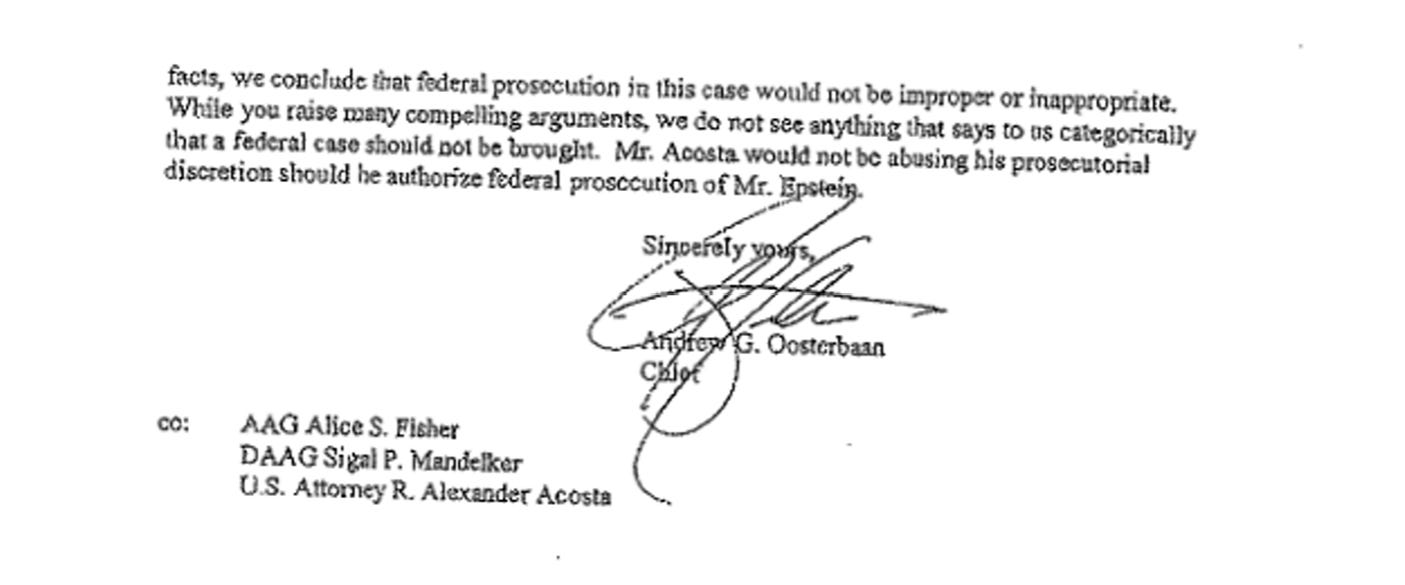
The letter then knocks down, in advance, the arguments Epstein’s team was trying to make:
The girls lied about their age. CEOS: that “is not dispositive of the issue.”
Nobody was forced. CEOS: the law “does not require the use of force, fraud, and coercion against minors. Because of their age, a degree of coercion is presumed.” They add that they’ve won these cases “even when the minors testified that not only did they voluntarily engage in the commercial sex acts, it was their idea to do so.”
Some girls don’t call themselves victims. CEOS: “a defendant’s criminal liability does not hinge on his victim identifying as having suffered at his hands.”
All three of those passages can be found on page 303 of EFTA00235628. It was filed in the victims’ Crime Victims’ Rights Act case as part of Exhibit A and released by the Justice Department earlier this year.
Thirty-five days after that letter was written, Stephanie Thacker made every one of those arguments anyway - to Oosterbaan’s boss.
What she wrote
Epstein’s lawyers went over CEOS’s head to the Deputy Attorney General’s office. On June 19, 2008 they dropped a stack of letters there. Ken Starr sent one…Thacker sent one…
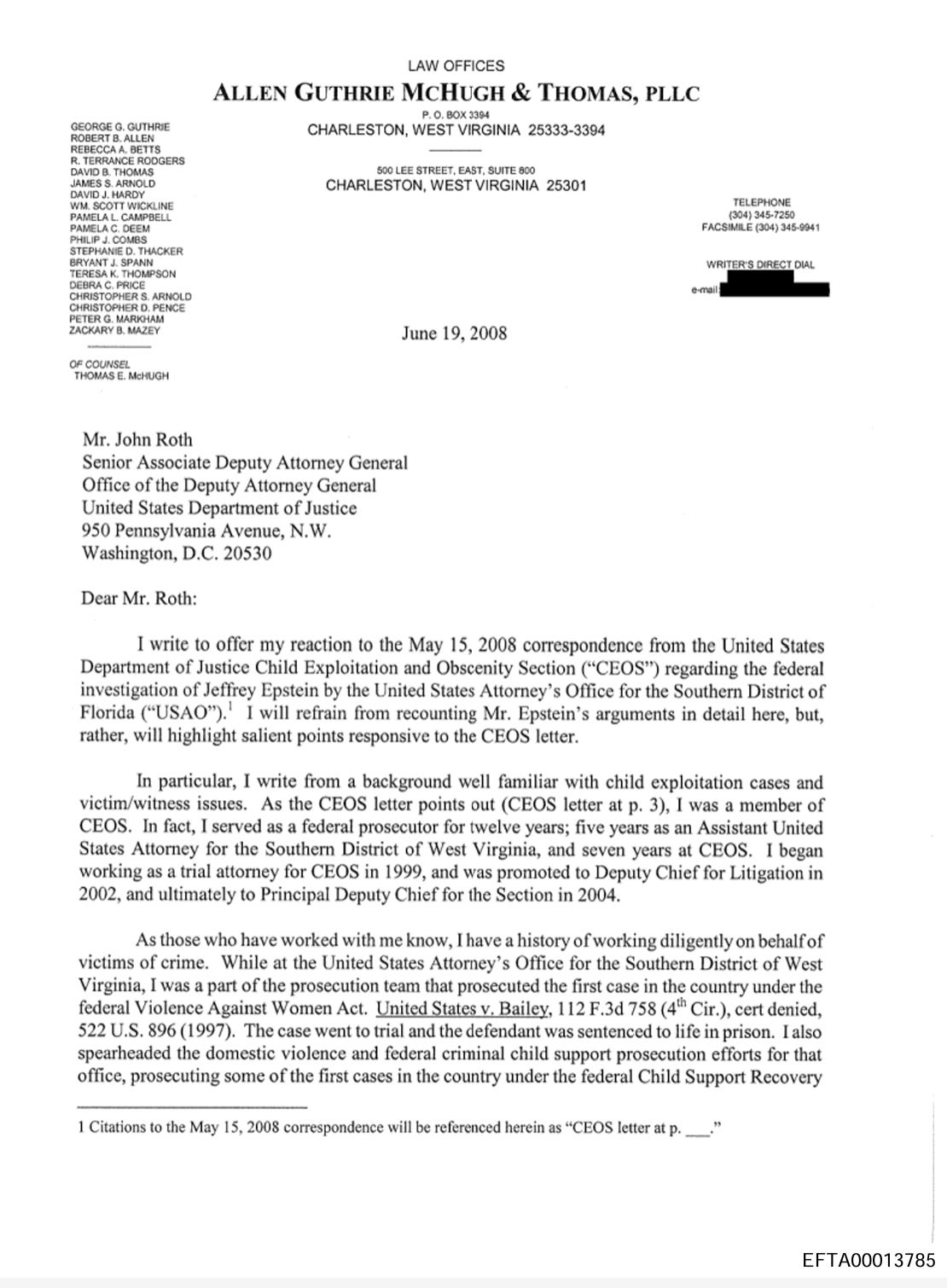
She opens by reminding everyone where she came from: “As the CEOS letter points out, I was a member of CEOS.”
Her conclusion is that a federal prosecution of Epstein “simply should not be countenanced.” Countenanced is an unnecessarily antiquated word that means allowed. She was essentially telling Main Justice that any decent Justice Department wouldn’t charge him.

On the girls, she identified two who were 14 and 15. Her argument was that they lied about their age. She also described 16 and 17 year old girls as “young women.”
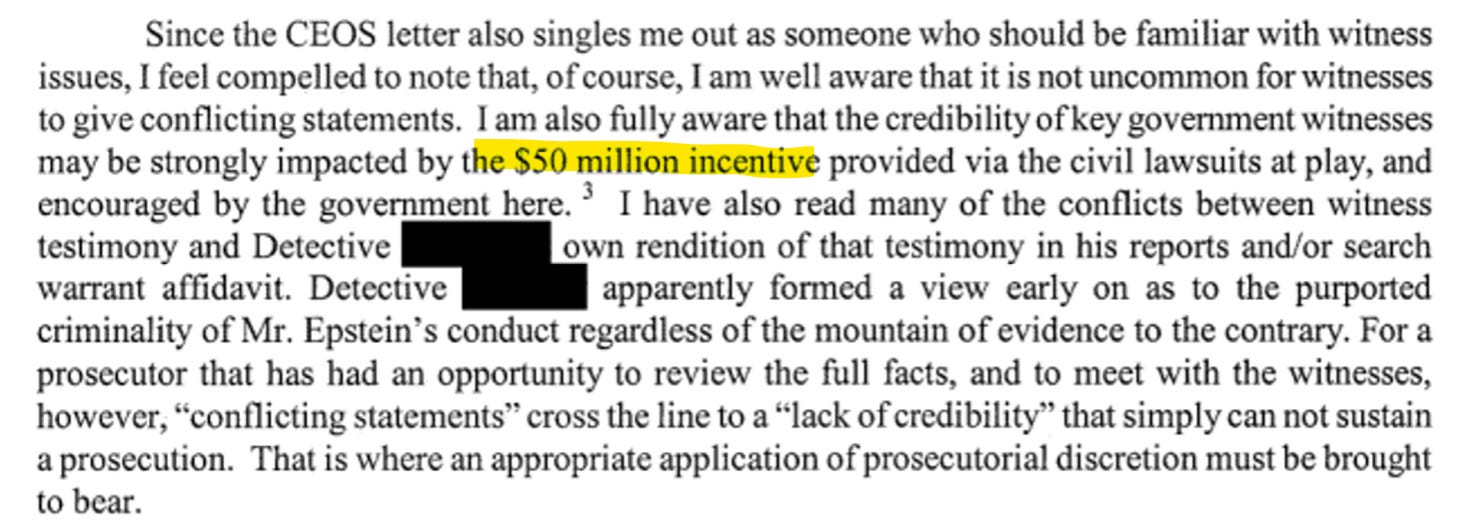
Because they’d filed civil suits, she wrote, “their testimony against Mr. Epstein is per se suspect.” She refers to “the $50 million incentive.” And in a footnote she went after one girl’s father and stepmother over their own criminal convictions. Her words: “Hardly pillars of credibility.”


On what Epstein did to the girls, she writes that during the massages Epstein “masturbated, engaged in some sexual touching, and a small number of alleged acts of penetration,” and that conduct with underage girls “only involved topless massages, massages in undergarments or naked massages.”
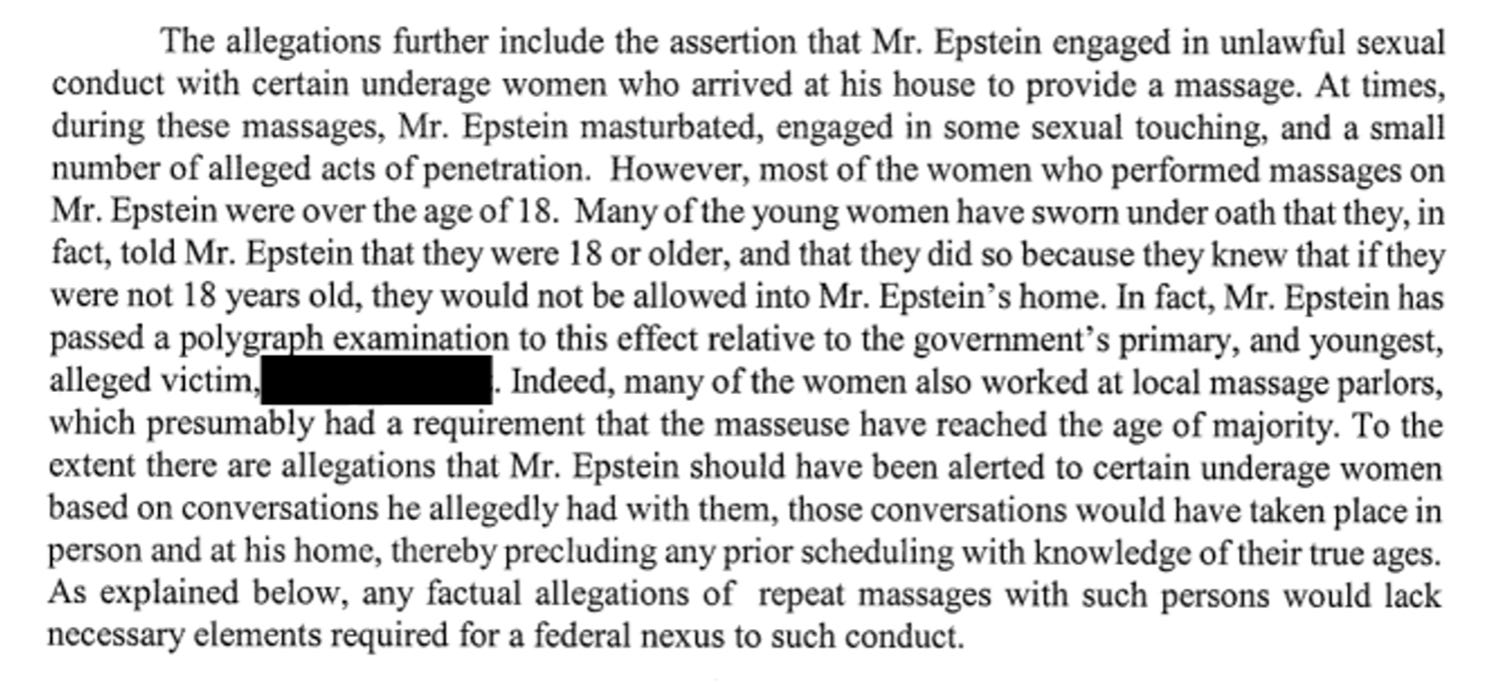
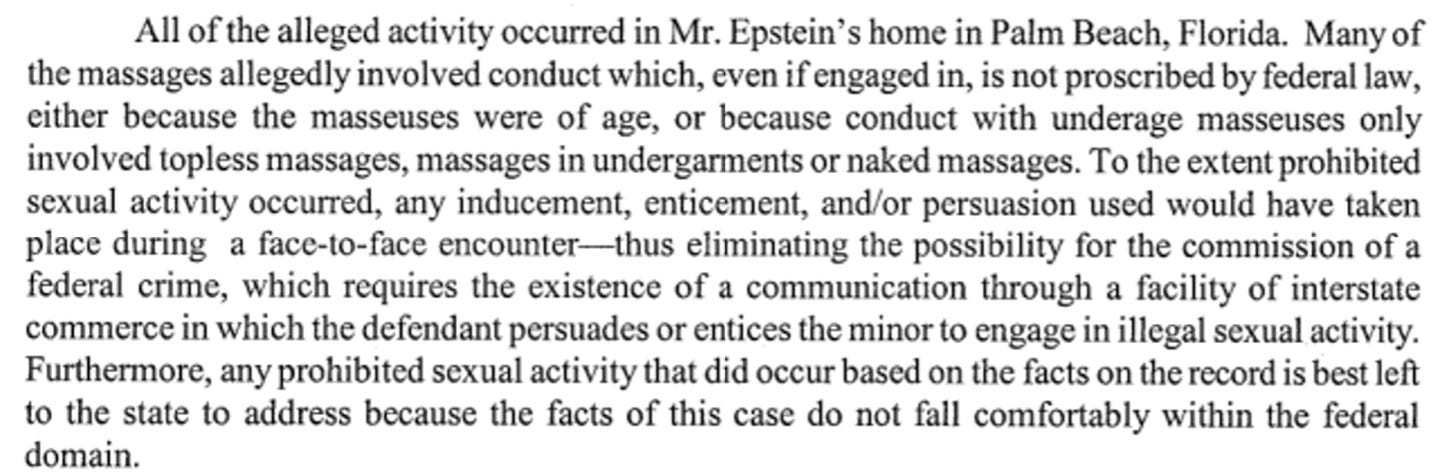
The words she chose were “some” and “only.” She referred to the girls as “underage masseuses” as if that’s an occupation.
On June 23, 2008, four days after Thacker's letter, a prosecutor emailed Epstein's lawyer that the Deputy Attorney General had finished his review and "determined that federal prosecution of Mr. Epstein's case [wa]s appropriate." Epstein had until close of business on June 30 to take the state plea he’d already agreed to, or face the federal charges in court. He took the deal.
On June 30, Epstein pled guilty in state court and went to a county jail where he was offered work-release six days a week. (A lawsuit filed by Kaitlin Doe alleges that work release didn’t stop him.)
A federal judge in Florida, Kenneth Marra, later found Epstein had abused more than 30 minor girls between about 1999 and 2007 - a fact the government didn't dispute.
Marra also found the government violated the victims’ rights under the Crime Victims’ Rights Act, the federal law that gives crime victims a say before their case is decided on. While Epstein’s lawyers were pressing his case with senior officials in Washington, the FBI was mailing his victims letters telling them the case was “currently under investigation” and asking for their “continued patience.” Marra called that a material omission.
He also wrote that while Epstein “was within his rights to attempt to persuade higher authorities within the Department of Justice to overrule the prosecutorial decisions of the U.S. Attorney’s Office,” the law was written to give the victims that same opportunity “to attempt to affect prosecutorial decisions before they became final.”
They didn’t get that.
The money
Five wires went from Epstein’s JPMorgan account to the account of the firm Thacker worked for - landing at a BB&T branch in Charleston, West Virginia. (You can see the firm she worked for in her email signature here.)
February 12, 2008: $11,843.58
April 4, 2008: $37,027.50
August 13, 2008: $19,490.13
December 10, 2010: $17,271.77
May 23, 2011: $791.00
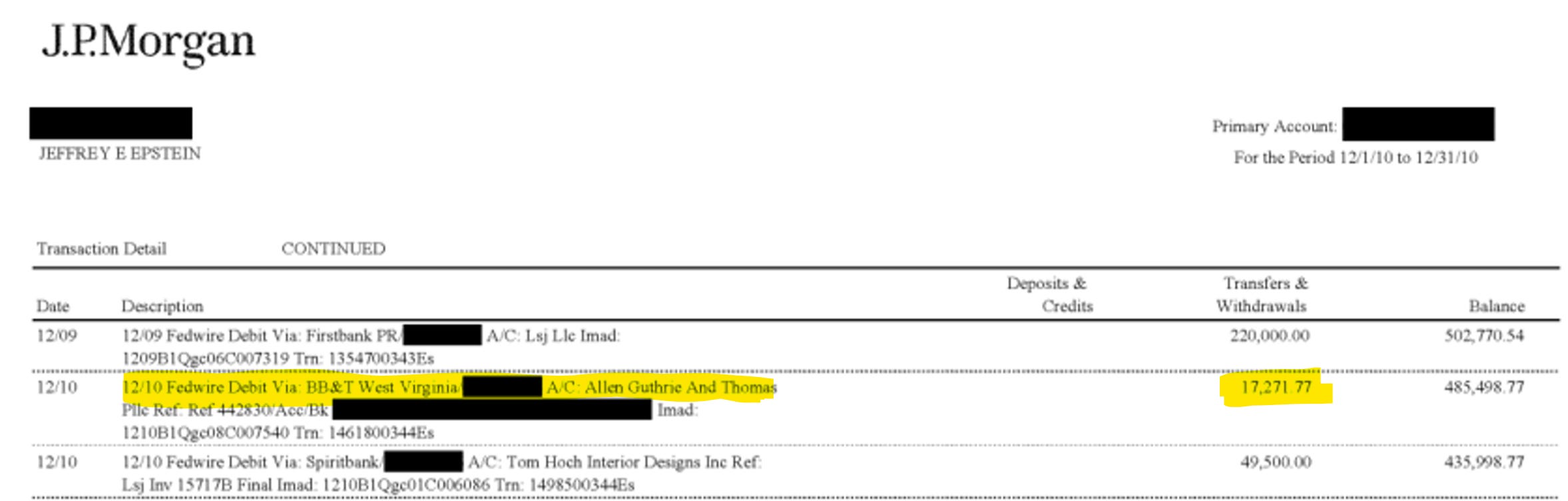
A forensic accountant’s tally of Epstein’s legal bills also lists $15,135.92 paid to “Stephanie Thacker” by name, labeled as if routed through another firm. Add it up and it’s over $101,000.

Epstein’s own bookkeeping tells you what he thought he was buying. His QuickBooks file codes the payments to account 50404: Legal.
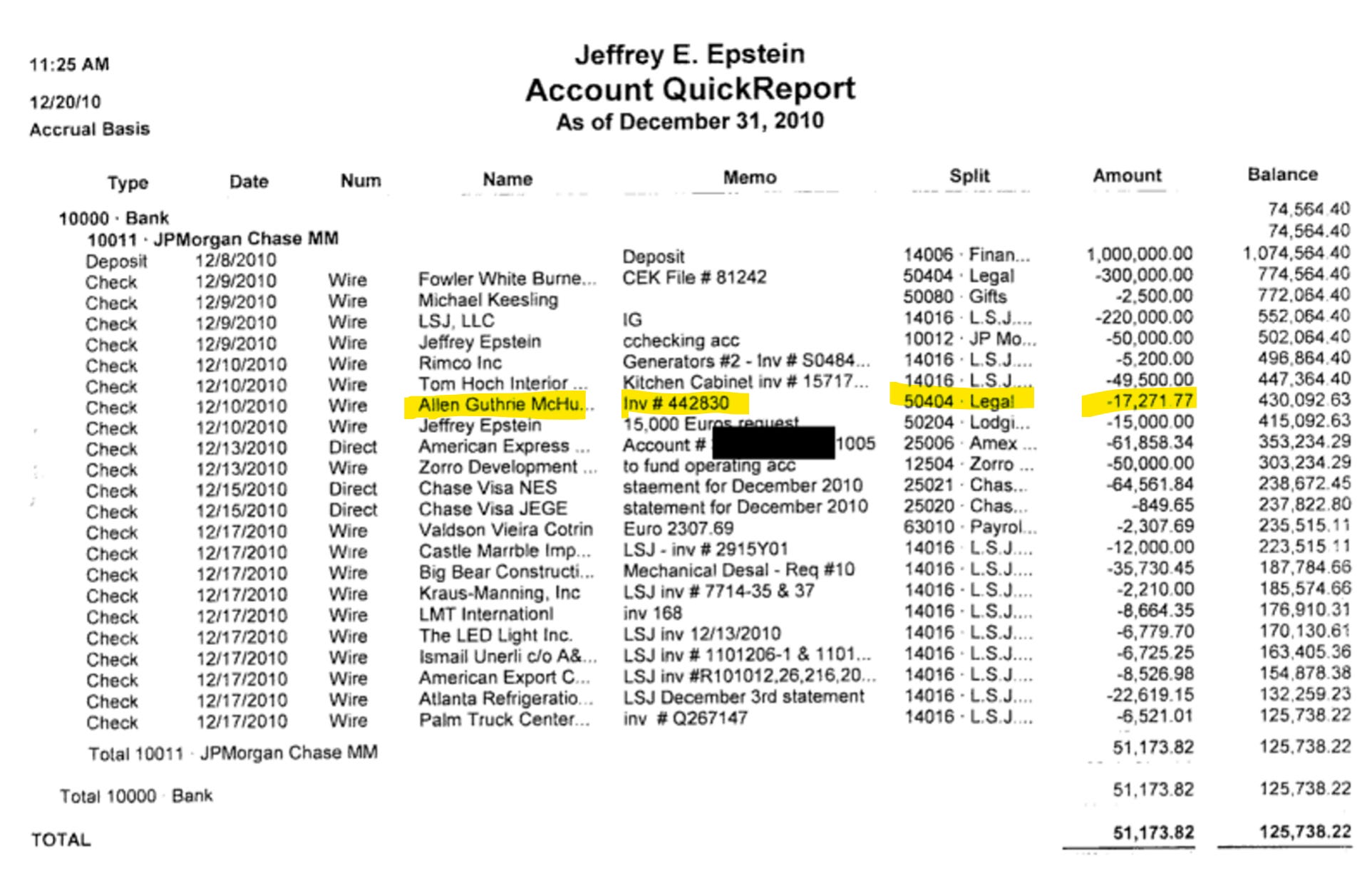
The biggest wire, $37,027.50, lands two and a half months before the letter. The $19,490.13 is sent August 13, which is after the letter, after Justice said no, and after Epstein pled guilty. The work was done, and the invoices got paid.
What the Senate was told
In September 2011 Thacker filled out the Senate Judiciary Committee questionnaire and swore in front of a notary that it was true and accurate.
Question 12(c) asks nominees to hand over any communications about public policy or legal interpretation they have sent to public officials.
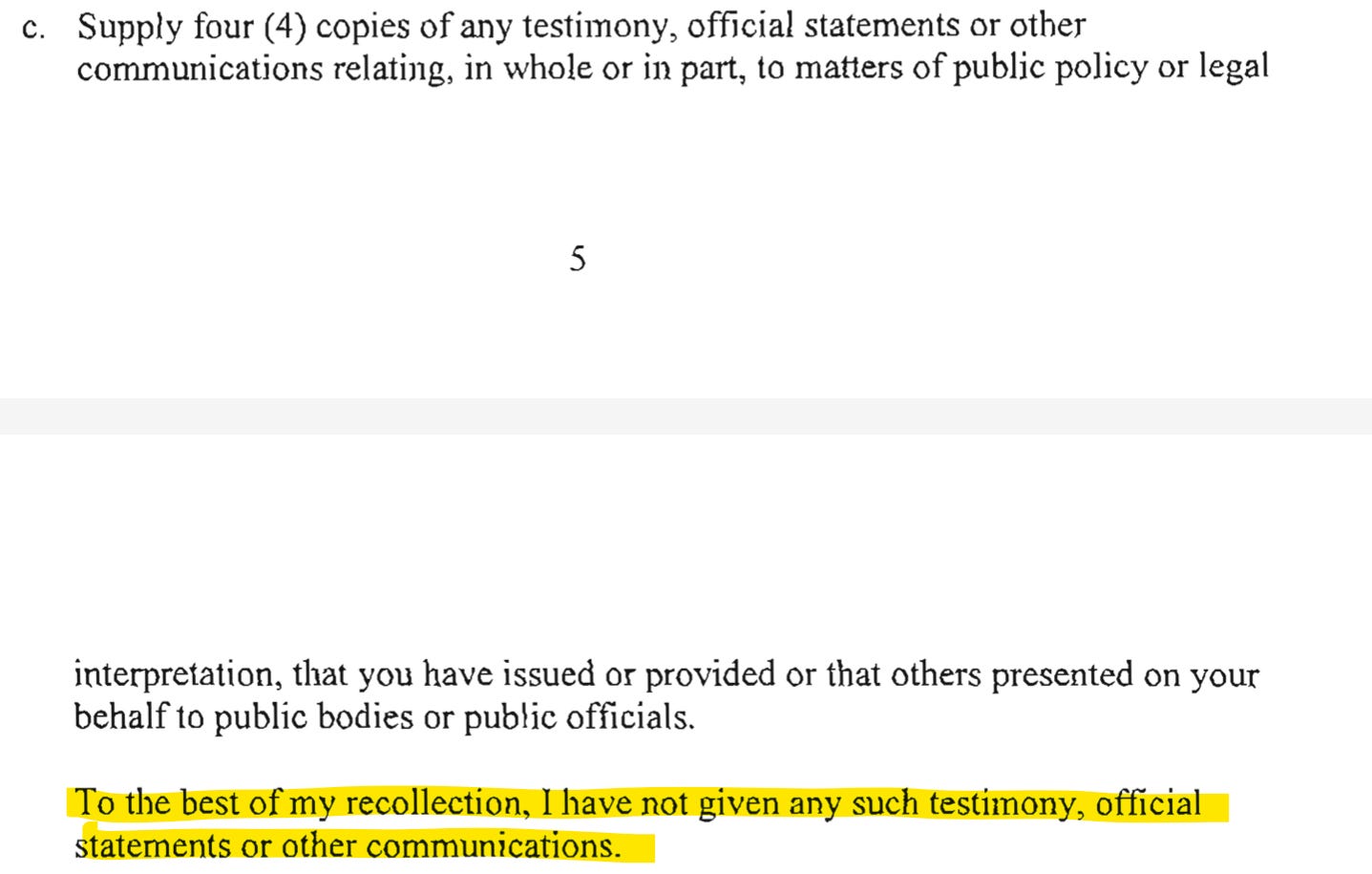
A letter to the Deputy Attorney General’s office arguing about which federal statutes reach a man’s conduct certainly seems like a communication to a public official about legal interpretation. Kind of feels like that’s the entire letter.
But take a look at the question just above it. Question 12(b) asked her to supply any reports or memoranda she had prepared. She listed the Federal Child Support Prosecution Handbook she co-wrote at the Justice Department, and answered that it “constitutes attorney work product and is not supplied.”
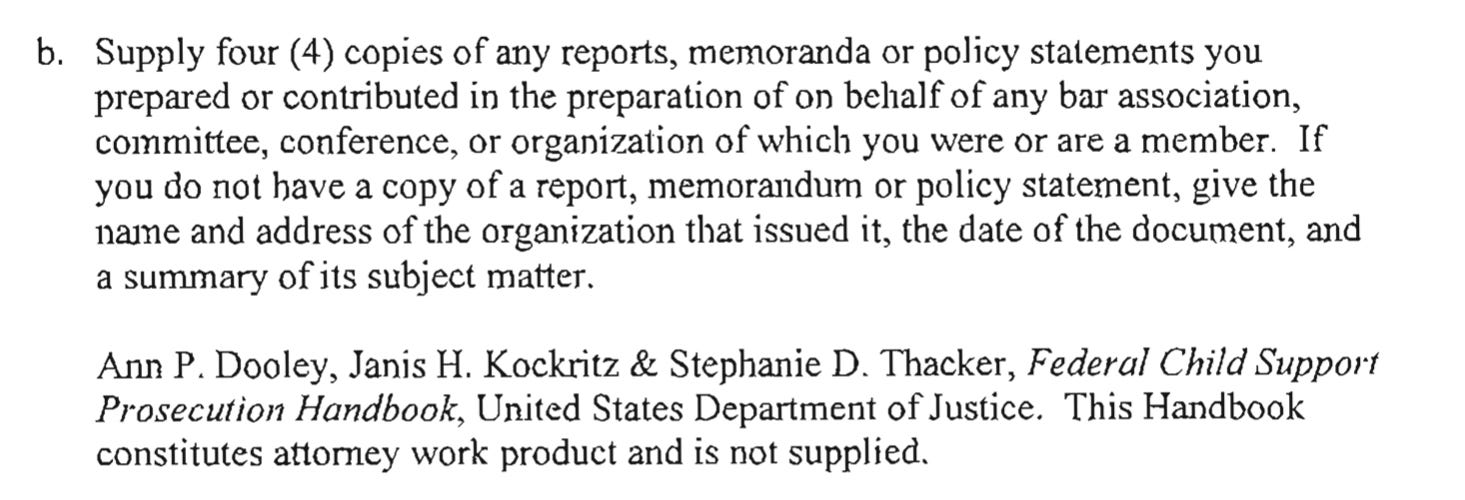
Thacker invoked privilege here. She did not invoke privilege in her response to 12(c) - she used the qualifier, “to the best of my recollection.” I guess it must have slipped her mind. And…it doesn’t look like anyone asked her about it. The written questions she got from Chuck Grassley were about her appellate briefs.
Question 18 asks for significant legal work including matters that never went to court. Her answer runs a page and a half about domestic violence, mine safety, and Innocence Lost. Epstein isn’t mentioned. She made room for this though…
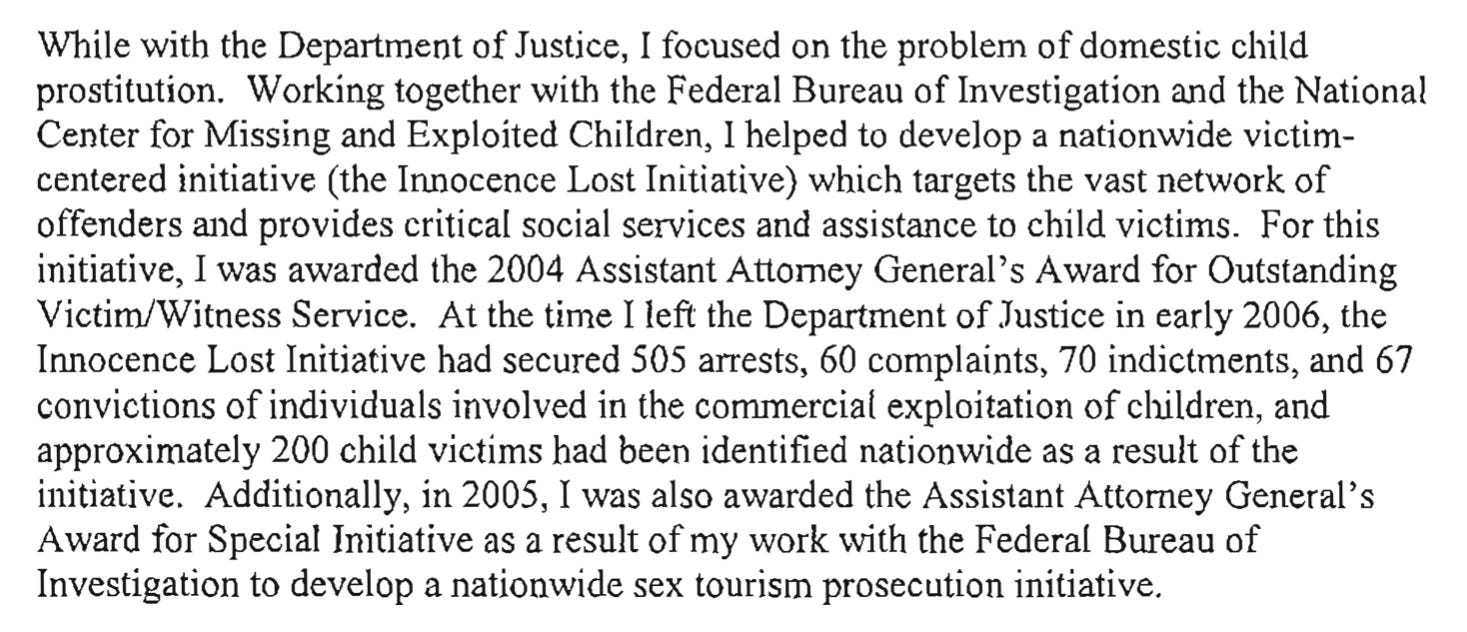
On April 16, 2012, Jay Rockefeller stood on the Senate floor and said Thacker “has dedicated much of her career to fighting some of the worst offenses in our society.” The announcement he and Joe Manchin put out said she “drafted laws designed to prevent child prostitution and sex tourism.”
All of it true. All of it also the exact thing Epstein had been doing when she submitted a letter in his defense.
What everyone else cost
Epstein’s financial records list what he paid for everyone else tasked with his defense. Alan Dershowitz, $3.49 million. Kirkland & Ellis, where Ken Starr worked, $2.4 million. Black Srebnick, $2.86 million. Gerald Lefcourt, $2.42 million. Martin Weinberg, $1.95 million. A private investigations firm, $391,699.96.
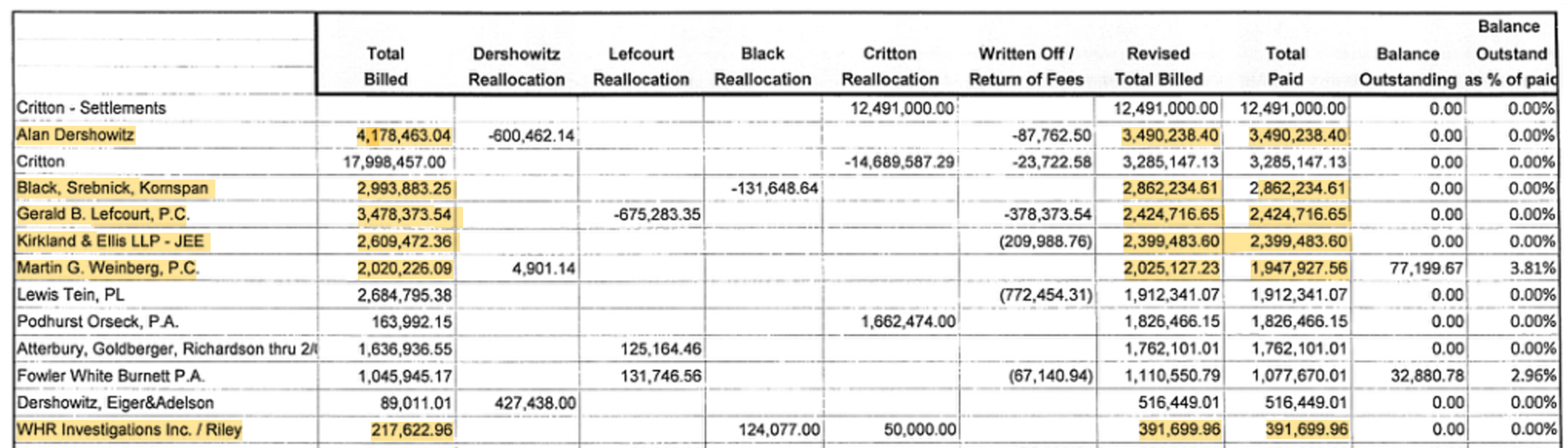
Meanwhile…

And of course the other incremental invoices to the firm she worked for - bringing the grand total to about $101,000.
She was the only one on the page who had helped run the Justice Department section that would have prosecuted him. Dershowitz couldn’t say that and he got over three million dollars.
No rules were broken
There’s a federal revolving-door law, 18 U.S.C. § 207. It permanently bars a former government lawyer from switching sides on a case they personally worked on, and blocks them for two years from matters under their authority in their final year. Thacker left CEOS in 2006, and nothing in the files shows she touched anything Epstein-related while she was there. So as far as the public record goes, she didn’t break it.
It was the law that let this happen. A former number two of the child exploitation section was able to use her old title as weight behind her legal punch. And for what? For a man her former colleagues were trying to indict.
Not one rule on the books had anything to say about it. How’s that for America?
Her letter was filed in open court on July 8, 2019, two days after Epstein was arrested at Teterboro. It sat on that docket for six and a half years. It went up on the Justice Department’s own website in January 2026. The only person who ever seemed to notice it was Steve Bannon, when Epstein texted him, bragging about it in May 2019.
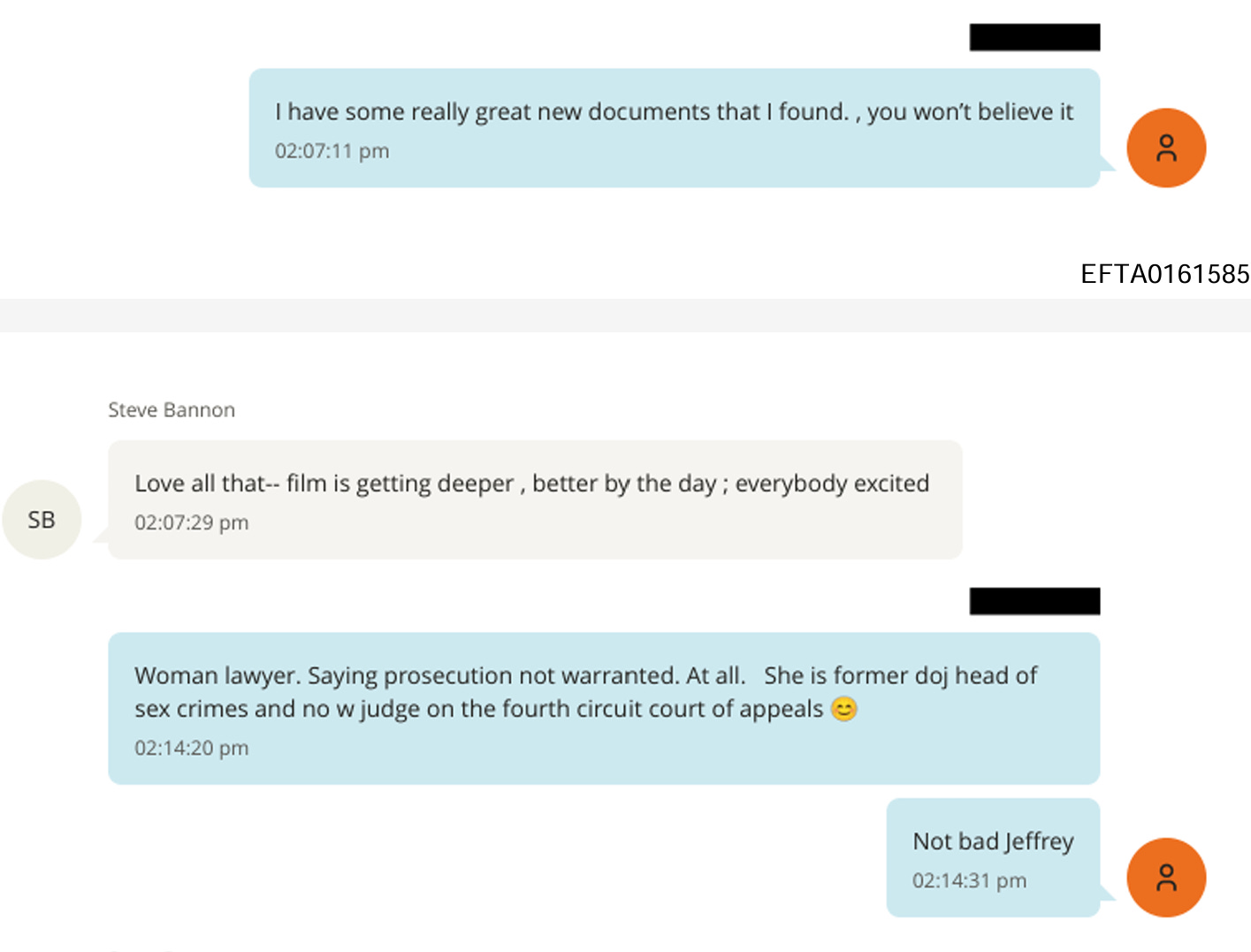
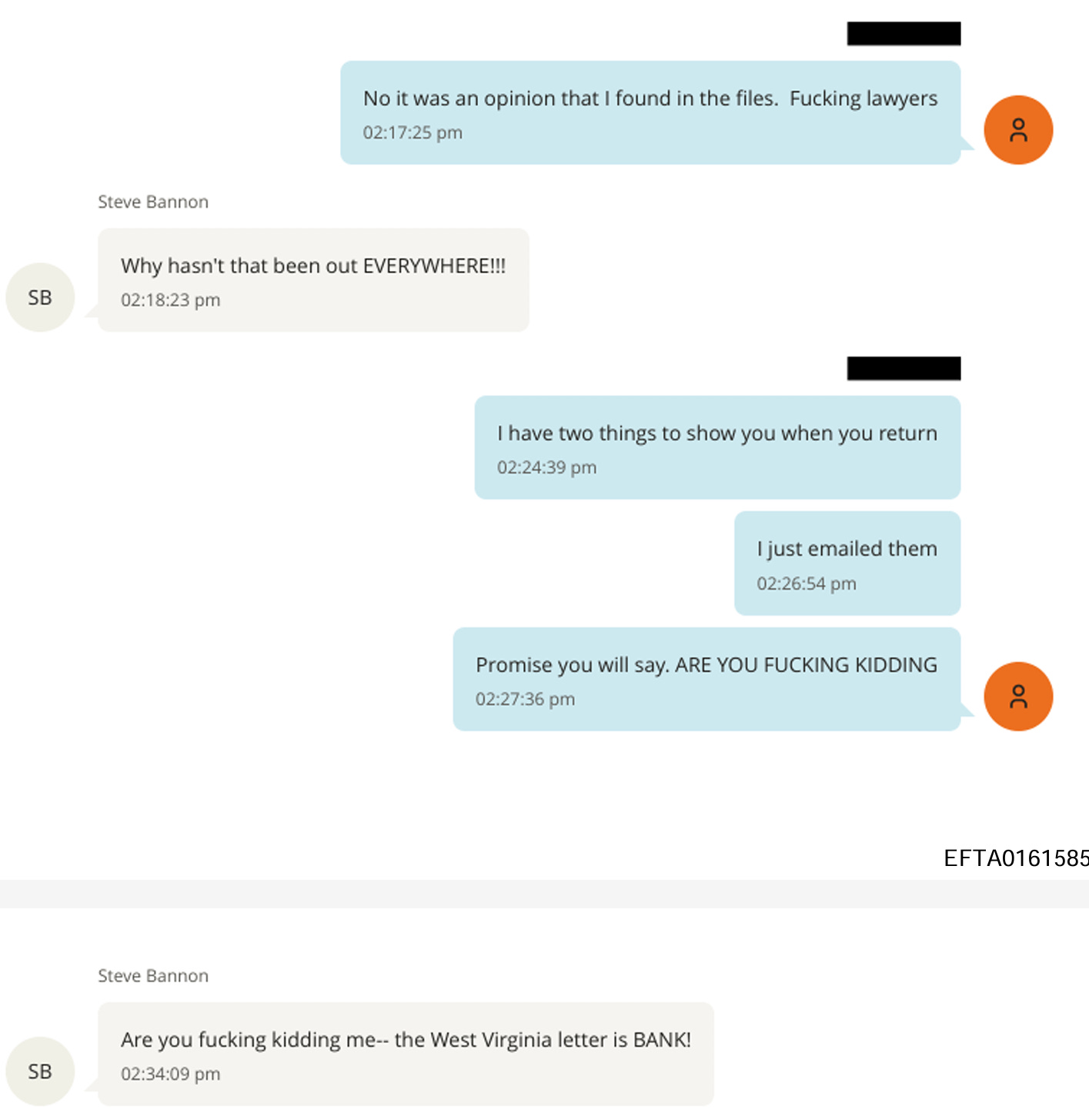
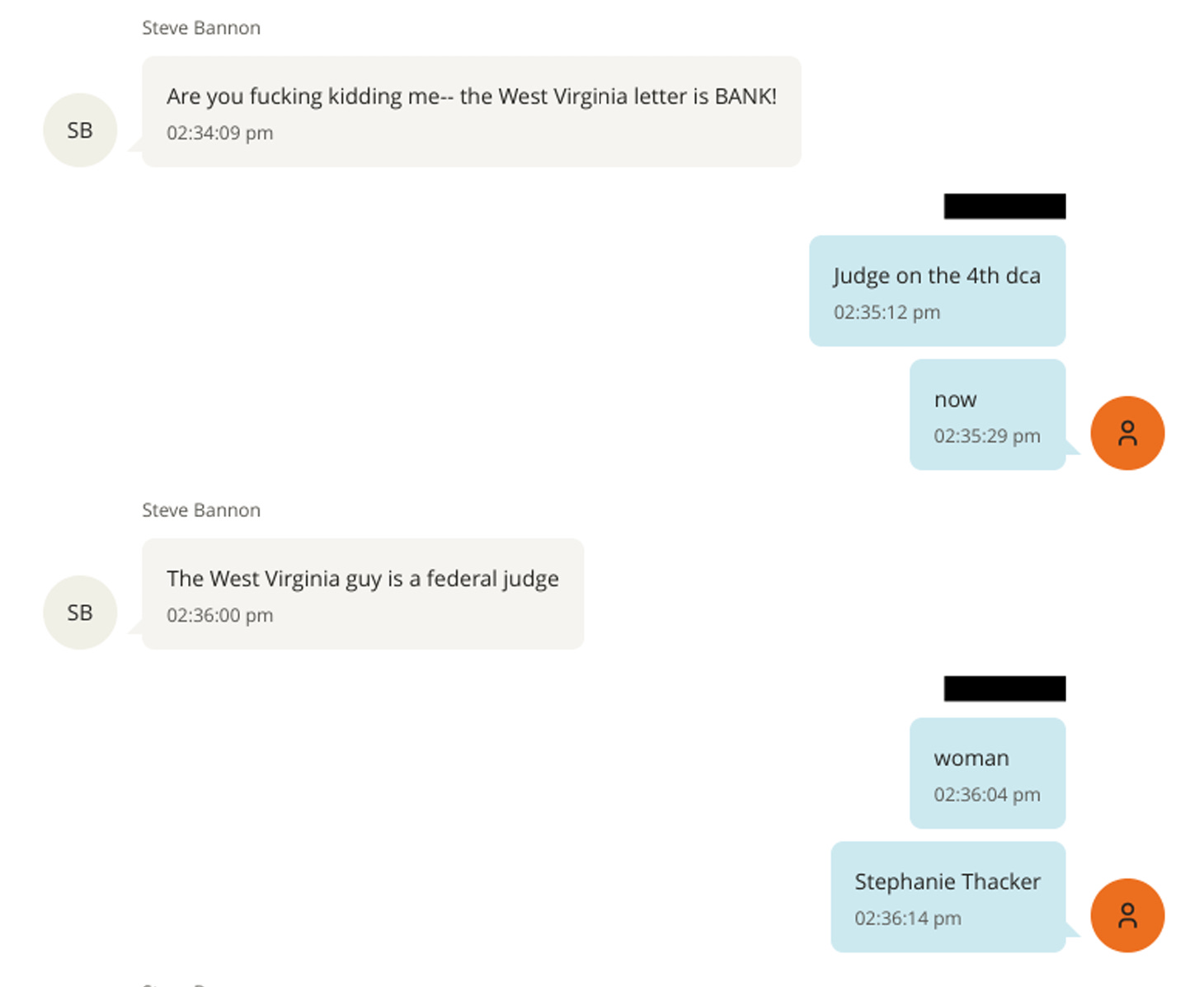
“Judge on the 4th dca” - “woman.” - “Stephanie Thacker.” Eleven years later, Thacker's letter and her old job fighting sex crimes at the DOJ were a bragging right Jeffrey Epstein liked to show off.
How do we know it was Epstein the DOJ redacted in the texts with Bannon? Because there’s more than one copy of the extraction in the files and they’re redacted differently. In the first screenshot, Bannon is named and the other person is redacted. In the one below, it's the reverse. Same exact message. Same exact date. Same exact time stamp.

Since 2012 Thacker has been deciding these cases herself. She wrote the Fourth Circuit's opinion in United States v. Mills, about a man who made child pornography, and in United States v. Stitz, about a man who distributed it. In McLamb and Seerden she ruled on how far investigators are allowed to go when they go looking for it. That’s fourteen years in the same corner of federal law she once told Washington did not reach Jeffrey Epstein.
And she’s still there.
The Federal Judicial Center lists her as a sitting judge of the Fourth Circuit, 2012 to present. She is in her 60s, the appointment is for life, and she cannot take senior status until 2030 at the earliest.
There is no public record of any senator asking her about the letter. There is no public mention of any committee pulling her paperwork. Nobody has publicly addressed whether she steps aside when one of these appeals lands on her desk.
The Fourth Circuit covers Maryland, Virginia, West Virginia, North Carolina and South Carolina. If someone is charged with a federal child sex crime in any of them, their appeal could be assigned to her.
Earlier this year, WBOY called Thacker's chambers to ask about the Epstein letter. Someone answered and said no comment.
Carrying out this kind of relentless, record-by-record oversight is heavy, exhausting work, but it is the only mechanism that truly holds entrenched power to account. When broader public attention drifts or outrage fatigue inevitably sets in, relying on a systematic methodology—linking hard financial transactions to travel manifests and auditing every administrative black bar—keeps the truth grounded in unassailable facts.
Refusing to let these documents dissolve into political noise or cynicism is a vital public service. By anchoring every piece of analysis directly in raw primary sources, you ensure that the historical record remains intact and that protective networks cannot simply wait out the news cycle. It takes extraordinary discipline to keep pulling at these dense, disturbing threads day after day, but that steady, methodical pressure is precisely how real accountability is built.
Impeach Judge Stephanie Thacker!!
“Senate confirmed her to a federal appeals court, 91 to 3“
Outrageous! She has proven record of protecting pædophiles!